How to Build an Enterprise AI Implementation Roadmap — Step-by-Step Guide (2026)
Discover essential steps on how to build an Enterprise AI implementation roadmap in 2026 to drive innovation and efficiency in your organization.
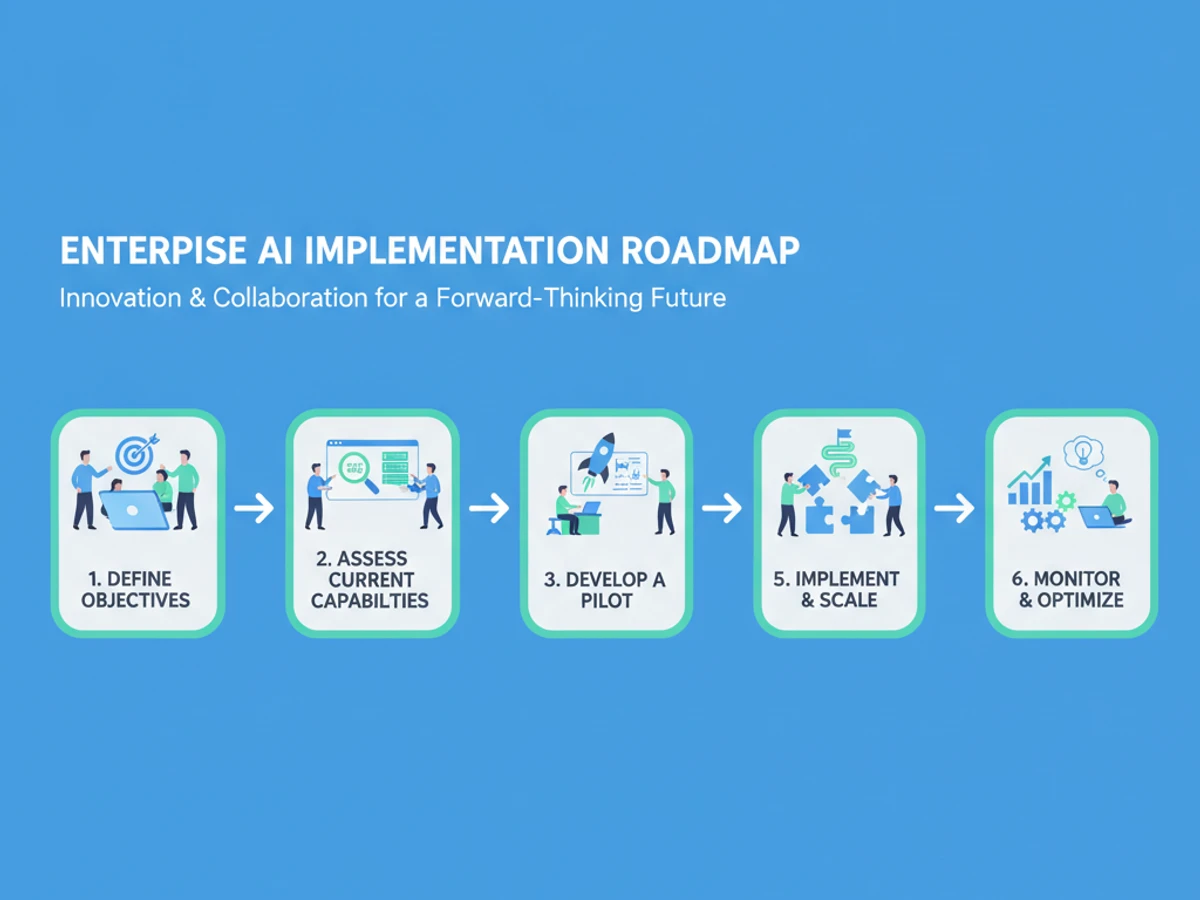
How to build an Enterprise AI implementation roadmap in 2026 | Updated August 2026 | Adspro Editorial Team | 6–12 weeks to complete the roadmap design process | Beginner
What You'll Learn
Building an Enterprise AI implementation roadmap in 2026 is the most valuable planning exercise a business leader can undertake this year. A solid roadmap ties AI investments directly to business results, aligns teams, and puts governance in place before deployment. This guide covers four essential phases: Discovery and Readiness Assessment, Use Case Prioritization, Pilot Execution, and Governed Scaling.
- Conduct an honest AI readiness audit across data, talent, and infrastructure
- Select and prioritize high-impact use cases using a structured scoring model
- Run a contained pilot that produces measurable, production-ready evidence
- Scale AI across business functions with governance frameworks built in from day one
Prerequisites: Executive sponsorship with budget authority, a cross-functional working group (business, IT, legal, and data leadership), and a baseline understanding of your current data infrastructure.
Why Building an Enterprise AI Implementation Roadmap Matters in 2026
Worldwide AI spending is forecast to exceed $2 trillion in 2026, according to Gartner. Yet McKinsey's 2025 State of AI survey reveals a critical gap: 88% of organizations use AI in at least one function, but only 39% report measurable EBIT impact, and just one-third are scaling it across the business. The gap between adoption and value capture is the defining enterprise challenge of 2026.
Organizations launch AI without a structured plan, clear priorities, or governance guardrails. A 2026 enterprise AI survey by Writer found that 79% of organizations face challenges in adopting AI, with 54% of C-suite executives admitting that adopting AI is creating organizational conflict.
An AI roadmap bridges business needs and technical capabilities, ensuring initiatives are intentional and connected to coherent transformation, not random experiments. The framework below closes the gap between experimentation and sustained, measurable ROI.
Key Takeaway: A structured AI roadmap addresses the primary 2026 challenge: bridging the gap between AI adoption and measurable value capture by aligning investments with business outcomes and establishing governance. For supporting data, see Enterprise AI Implementation Roadmap and Timeline.
The Process at a Glance
| Step | Action | Time | Outcome |
|---|---|---|---|
| 1 | Conduct an AI discovery and readiness audit | 2–3 weeks | Honest baseline of data and talent gaps |
| 2 | Prioritize use cases with a scoring model | 1–2 weeks | Ranked portfolio of high-ROI AI initiatives |
| 3 | Run a time-boxed, measurable pilot | 6–8 weeks | Production-ready evidence and go/no-go decision |
| 4 | Scale with governance and operating model | Ongoing (Month 4+) | Enterprise-wide AI embedded in core workflows |
Total time to a board-ready roadmap document: 6–12 weeks. Full scaled deployment typically spans 12–18 months.
Step 1: Conduct an AI Discovery and Readiness Assessment
What You're Doing
Before selecting technology or vendors, establish an objective baseline of where your organization stands across data quality, infrastructure, talent, and executive alignment. This quality gate determines the success of all subsequent phases.
How to Do It
- Secure a named executive sponsor. Enterprise AI implementation requires one clear executive sponsor who can protect budget and clear organizational resistance.
- Audit your data estate. 70% of AI failures originate from unresolved data issues. Evaluate data quality, completeness, lineage, and accessibility across every system of record. Talk to people actually using this data daily; they surface problems dashboards hide.
- Assess infrastructure and talent gaps. An AI readiness assessment evaluates your organization's ability to successfully adopt and scale artificial intelligence — examining strategy, data quality, infrastructure capacity, talent availability, and governance frameworks. Do you have cloud capacity? Do you have data engineers on staff? Can your security team keep pace with model deployments?
- Define your strategic intent. Leadership must agree whether the primary objective is efficiency (cost reduction), growth (new revenue), resilience (risk reduction), or customer experience improvement.
- Document findings in a readiness scorecard that rates each dimension on a 1–4 scale and identifies the top three blockers to production deployment.
Best Practices
- Treat this assessment as a discovery conversation, not an audit. Organizations following a readiness-first approach outperform those that don't by a wide margin on ROI, according to BCG's 2026 AI Readiness Report.
- Engage a specialized partner early. Expert AI consulting can cut roadmap timelines from 6–12 months to 2–4 months while minimizing implementation risk.
Common Mistakes
- Confusing data volume with data readiness. Having large amounts of data is ineffective if the data is not accurate.
- Launching pilots before establishing data governance, assuming existing IT teams can manage AI projects without additional training, and ignoring security requirements until deployment.
What Done Looks Like
You have a written readiness scorecard, a named executive sponsor, a list of the top three data or infrastructure gaps, and leadership agreement on strategic intent.
Example
A mid-size U.S. manufacturer discovers that customer order data lives in three disconnected systems with no unified identifier. Rather than proceeding to model selection, the team builds a consolidated data layer — preventing a failed demand-forecasting pilot three months later. This is the readiness-first approach in practice.
Working with a strategy-led partner like Adspro adds early leverage, providing a structured view of where to start before any technology spend is committed.
Key Takeaway: A thorough AI readiness assessment focusing on data quality, infrastructure, talent, and executive sponsorship is critical to prevent common pitfalls. For a more detailed walkthrough, see Enterprise AI Strategy & Implementation Roadmap.
Step 2: Prioritize Use Cases With a Value-Feasibility Scoring Model
What You're Doing
Build a ranked portfolio of AI opportunities using a structured scoring model, then select 1–3 high-confidence use cases for the pilot phase. This avoids the most common trap: pursuing strategically interesting but operationally immature use cases.
How to Do It
- Collect candidate use cases from each business unit. Limit submissions to problems where a measurable outcome already exists.
- Score each use case across three dimensions:
- Financial impact: Will this reduce labor, cut errors, improve cycle time, or protect margin that finance can verify?
- Technical feasibility: Is the process stable, is data accessible, and can the workflow integrate with current systems?
- Strategic urgency: Does this solve a pressing operational constraint, compliance issue, customer pain point, or scaling bottleneck?
- Apply a 1–3 score to each dimension per use case. Total scores above 7 advance to pilot consideration; scores below 5 are deferred.
- Select 1–3 use cases for the pilot phase, prioritizing the highest-scoring initiative with the shortest time-to-evidence.
Example: Use Case Scoring Table
| Use Case | Financial Impact (1–3) | Technical Feasibility (1–3) | Strategic Urgency (1–3) | Total Score | Decision |
|---|---|---|---|---|---|
| AI-assisted customer service routing | 3 | 3 | 2 | 8 | Advance to Pilot |
| Autonomous contract review | 2 | 2 | 3 | 7 | Advance to Pilot |
| Generative AI for product R&D | 3 | 1 | 2 | 6 | Defer — data not ready |
| Predictive supply chain optimization | 3 | 1 | 1 | 5 | Defer — infrastructure gap |
Best Practices
- According to McKinsey research, organizations using value-versus-feasibility scoring achieve 30–50% faster time-to-value. A rigorous scoring process filters out immature initiatives, ensuring resources focus on high-ROI projects.
What Done Looks Like
You have a documented use-case portfolio, clear scoring rationale, 1–3 pilot candidates with defined baseline metrics, and leadership sign-off on prioritization criteria.
Key Takeaway: Prioritizing AI use cases with a structured value-feasibility scoring model focuses resources on high-impact initiatives and avoids pursuing technically immature projects.
Step 3: Run a Time-Boxed, Measurable Pilot
What You're Doing
Execute a contained 6–8 week pilot on your highest-scoring use case to produce production-quality evidence. Every pilot must have a pre-defined success threshold that triggers either a go-to-production decision or a structured stop.
How to Do It
- Define the success threshold before you start. You need baseline productivity metrics before deploying anything. Example: "Customer routing accuracy must improve from 71% to 85% within six weeks."
- Assemble a cross-functional pilot team: a business owner, data engineer, ML practitioner, compliance representative, and end-user champion.
- Stand up a minimal viable data pipeline for the use case only. Do not attempt to solve all data quality issues enterprise-wide during the pilot.
- Deploy in a controlled environment with real data but limited blast radius — one team, one region, or one product line.
- Instrument the pilot for measurement: capture baseline metrics on day one and measure the same metrics at week four and week eight.
- Hold a go/no-go review at the end of the pilot window. Organizations that achieve measurable ROI do not skip phases to save time — they treat each phase as a quality gate.
Common Mistakes
- Only around 54% of AI projects make it from pilot to production, with the rest failing due to unclear objectives, poor data quality, or missing executive sponsorship. Defining these before the pilot starts is the differentiator.
- Expanding scope mid-pilot. A pilot addressing three problems simultaneously produces evidence for none of them.
What Done Looks Like
You have a written pilot results document showing before-and-after metrics, a production readiness assessment, a clear go/no-go recommendation, and a documented list of data, infrastructure, and process changes required for production.
Key Takeaway: A time-boxed, measurable pilot with clearly defined success thresholds generates production-quality evidence and prevents wasted resources on unproven initiatives.
Step 4: Scale With Governance and a Defined Operating Model
What You're Doing
Move successful pilots into production and build organizational infrastructure to sustain and expand AI across the enterprise — including governance frameworks, MLOps pipelines, and a defined operating model. This is where AI stops being an experiment and becomes a business capability.
How to Do It
- Establish an AI governance committee with cross-functional representation from legal, compliance, IT, data, and business units. An AI governance committee is a cross-functional body responsible for defining policies for data privacy, security, and ethical AI usage, creating model validation processes, addressing bias detection, and ensuring compliance with GDPR, CCPA, and sector-specific regulations.
- Stand up an MLOps environment that handles model deployment, monitoring, retraining triggers, and version control. MLOps (Machine Learning Operations) is a set of practices for deploying and maintaining machine learning models in production reliably and efficiently.
- Define your AI operating model: who owns each model in production, who manages data pipelines, how new use cases enter prioritization, and which roles need to be added or retrained.
- Build a Center of Excellence (CoE). A Center of Excellence (CoE) is a centralized team or function that provides leadership, best practices, research, support, and training for AI. Nearly 60% of high-maturity organizations centralize AI strategy, governance, data, and infrastructure under a CoE structure.
- Expand the use-case portfolio by re-running Step 2 scoring quarterly using production performance data to calibrate feasibility scores more accurately.
Best Practices
- Workflow redesign is the number-one factor linked to measurable AI ROI. Enterprises see bottom-line impact only when AI is embedded directly into processes — not as standalone tools adjacent to existing workflows.
- 78% of organizations that successfully deployed AI worked with external partners for at least part of the implementation, according to IDC and Gartner data compiled by Medha Cloud. A long-term partner relationship reduces organizational overhead of rebuilding institutional knowledge with each new initiative.
Common Mistakes
- Treating AI as isolated pilots instead of long-term investments, failing to scale successful pilots across the enterprise, and operating with no cross-department collaboration are the three most common scaling failures.
What Done Looks Like
At least one AI model runs in production with active monitoring, a governance committee meets on a defined cadence, an MLOps environment is operational, and a prioritized pipeline of the next three use cases is ready for the pilot phase.
Adspro serves as an end-to-end partner for enterprises navigating the complexity of governed scaling. Their services span AI strategy, data engineering, enterprise software, and customer experience design — covering exactly the operating model and governance layers that most in-house teams find hardest to stand up alone.
Key Takeaway: Scaling AI successfully requires robust governance, a defined MLOps environment, a clear operating model, and often a Center of Excellence to ensure sustained impact.
What to Do After Completing Your Roadmap
Phase 1: Optimize (Months 4–9)
Move your first production model into a continuous improvement cycle. Establish retraining cadences based on model drift thresholds, not calendar schedules. Use real usage data to refine your scoring model and launch the second use case from your prioritized portfolio.
Phase 2: Expand (Months 9–18)
Bring additional business units into the roadmap using your proven pilot playbook. The CoE standardizes data pipeline architecture and governance controls so each new use case does not require rebuilding the foundation. By 2026, experimentation without prioritization has become expensive noise — the CoE ensures every initiative is intentional.
Phase 3: Transform (Month 18+)
Systematic AI integration with governance frameworks evolves into AI-driven decision-making at scale, autonomous systems, and continuous innovation. The roadmap itself becomes a living document refreshed quarterly against business strategy.
Resources You'll Need
| Resource | Role in the Process | Required / Recommended / Optional | Cost |
|---|---|---|---|
| Adspro.xyz | End-to-end AI strategy, data engineering, and implementation partner — covers Discovery through Scale | Recommended | Engagement-based (contact for scope) |
| IBM watsonx | Enterprise AI platform for building, deploying, and governing models in hybrid cloud environments | Recommended | Subscription-based (contact IBM for enterprise pricing) |
| McKinsey State of AI Report | Annual benchmark data for validating use-case prioritization and ROI assumptions | Recommended | Free |
| Gartner AI Strategy Research | Maturity models, magic quadrant assessments, and governance frameworks for enterprise AI | Recommended | Subscription (some reports free with registration) |
| Stanford HAI AI Index Report | Annual primary research on AI adoption rates, investment trends, and workforce impact | Optional | Free |
See also, see Best Practices in Developing an Enterprise AI Roadmap.
Troubleshooting Common Issues
Problem: The pilot delivered results, but leadership will not approve production funding
Fix: Translate pilot results into financial language: annualized labor savings, error-reduction cost avoidance, or revenue cycle improvement. Present a 12-month ROI model, not a technical performance report.
Problem: Data quality issues are blocking the pilot before it starts
Fix: Narrow the pilot scope to the one data source with the highest quality. Build one clean, governed data pipeline for that use case, prove the model works, and use the production evidence to justify a broader data modernization investment. Gartner predicts that through 2026, organizations will abandon 60% of AI projects unsupported by AI-ready data.
Problem: AI initiatives are stalling because different teams are using incompatible tools
Fix: Pause new tool procurement. Conduct a technology audit across all active AI experiments, identify the two or three platforms that cover the majority of use cases, and establish those as the enterprise standard. Gartner warns that over 50% of enterprise AI initiatives fail to reach production through 2027 because foundational architecture is missing.
Problem: The program loses momentum after the first successful pilot
Fix: Stand up the CoE before the second pilot begins. Assign a permanent product owner to each production model and formalize the use-case intake process so the roadmap runs as a program, not a series of one-off projects.
Key Takeaway: Common AI implementation issues can be mitigated by focusing on financial ROI, narrowing scope, standardizing platforms, and establishing a robust Center of Excellence. For more troubleshooting advice, see Most Common Mistakes Companies Make When Developing ....
Conclusion
Key Takeaways
- Outcome recap: Building an Enterprise AI implementation roadmap in 2026 means completing four sequential phases — Discovery, Prioritization, Pilot, and Scale — each treated as a quality gate that earns the right to advance to the next.
- Key insight: The difference between organizations that succeed and those that stall is how AI strategy is approached from the beginning. Readiness before tooling, governance before scaling.
- Next action: Schedule a discovery or strategy session — internally or with a partner like Adspro — within the next two weeks. That single conversation is the practical starting point for your roadmap.
FAQ
How do you build an Enterprise AI Implementation Roadmap?
Building an Enterprise AI Implementation Roadmap requires four sequential phases: conduct an AI readiness assessment auditing data quality, infrastructure, talent, and executive alignment; run a structured use-case prioritization using value-versus-feasibility scoring to identify 1–3 high-confidence initiatives; execute a time-boxed pilot (6–8 weeks) with pre-defined success thresholds and real baseline metrics; and scale successful pilots into production under a governance framework including an AI ethics committee, MLOps infrastructure, and a Center of Excellence. Each phase acts as a quality gate — you do not advance until you have documented evidence the current phase is complete. Total time from discovery to a board-ready roadmap is 6–12 weeks; full scaled deployment typically spans 12–18 months.
What is the biggest reason enterprise AI initiatives fail?
Failures stem from starting with technology instead of business problems, underestimating data quality and governance requirements, treating AI as an isolated IT initiative, and deferring MLOps and production planning. Poor data readiness is the single most cited root cause: 72% of businesses potentially shut down AI pilots due to poor data readiness rather than technology limitations.
How long does it take to build an enterprise AI roadmap?
Expert AI consulting can cut roadmap creation timelines from 6–12 months to 2–4 months through proven frameworks. For most enterprises working internally, the roadmap design phase takes 6–12 weeks. Full journey from roadmap completion to scaled production deployment typically spans 12–18 months across multiple use cases.
What does AI readiness mean, and how do you assess it?
AI readiness refers to an organization's ability to adopt, deploy, and sustain artificial intelligence at scale. An AI readiness assessment evaluates your organization's ability to successfully adopt and scale artificial intelligence — examining strategy, data quality, infrastructure capacity, talent availability, and governance frameworks. This means auditing whether your data is labeled, accessible, and governed; whether your cloud and compute infrastructure can support model training and inference; whether you have data scientists or ML engineers on staff or access to them; and whether an executive sponsor with budget authority is in place.
How should enterprises prioritize AI use cases?
Use a structured scoring model evaluating each use case across financial impact, technical feasibility, and strategic urgency. According to McKinsey research, organizations using value-versus-feasibility scoring achieve 30–50% faster time-to-value. Score each dimension 1–3, advance anything scoring 7 or above to pilot consideration, and defer lower-scoring initiatives until gaps are resolved.
What is an AI Center of Excellence, and does every enterprise need one?
A Center of Excellence (CoE) is a centralized team or function that provides leadership, best practices, research, support, and training for AI. Nearly 60% of high-maturity organizations centralize AI strategy, governance, data, and infrastructure under a CoE structure. Organizations running fewer than three production AI models can manage with a designated AI program owner. Once scaling beyond three active use cases or multiple business units, a CoE prevents tool sprawl, duplicated effort, and inconsistent governance.
What AI governance requirements should enterprises plan for in 2026?
Establish an AI governance committee with cross-functional representation, define policies for data privacy, security, and ethical AI usage, create model validation processes, address bias detection, and ensure compliance with GDPR, CCPA, and sector-specific regulations. State-level AI legislation is accelerating, making proactive governance a legal necessity. Only 34% of enterprises report their AI programs produce measurable financial impact, and less than 20% have mature governance frameworks in place.
When should an enterprise hire an external AI implementation partner?
78% of organizations that successfully deployed AI worked with external partners for at least part of the implementation. An external partner is most valuable during the readiness assessment and roadmap design phase (where objectivity and benchmarking experience accelerate discovery) and during the governance and scaling phase (where MLOps, data engineering, and operating model design require specialized skills most enterprise IT teams do not maintain in-house). A partner like Adspro provides continuity across all four roadmap phases rather than requiring enterprises to re-onboard a new vendor at each stage.
Methodology: This guide was developed through primary research across published enterprise AI adoption surveys and analyst reports from Gartner, McKinsey, Stanford HAI, PwC, and Deloitte. Statistics are attributed to their original publishing sources. This article is intended for educational and planning purposes and does not constitute legal, compliance, or financial advice. Regulatory requirements vary by industry and jurisdiction — consult qualified legal counsel before implementing AI governance policies. Last reviewed: August 2026.