How to Implement Generative AI in Enterprise Workflows 2026 — Step-by-Step Guide (2026)
Discover how to implement generative AI in enterprise workflows step by step with our comprehensive guide for 2026, enhancing efficiency and innovation.
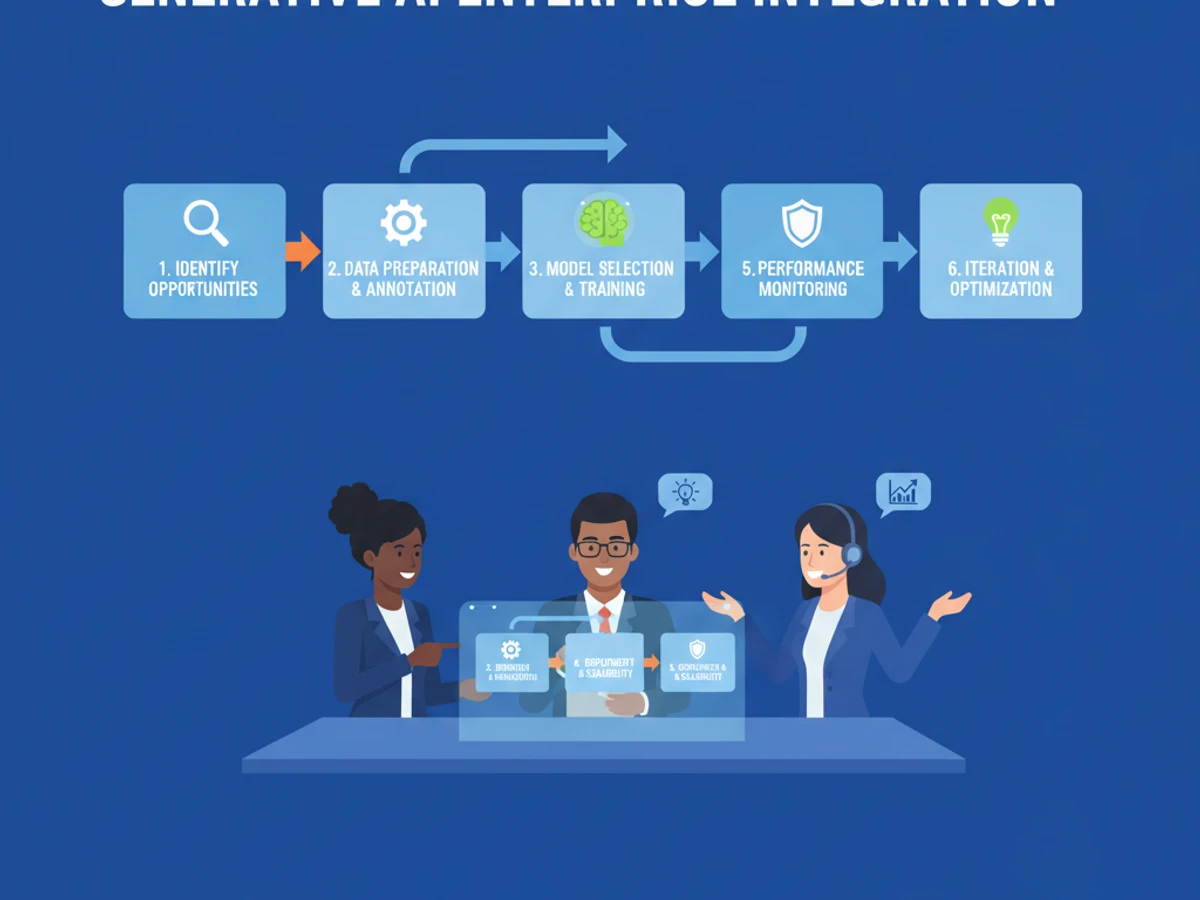
how to implement generative AI in enterprise workflows step by step | Updated August 2026 | Adspro.xyz Editorial Team | 8–16 weeks to first production deployment | Beginner
What You'll Learn
This guide provides a definitive step-by-step approach to implementing generative AI in enterprise workflows: start with a focused use case tied to measurable business outcomes, ensure your data is AI-ready, run a time-boxed pilot, build governance before scaling, and expand systematically. You will learn to:
- Identify and prioritize high-impact AI use cases before writing a single line of code
- Assess and prepare your data infrastructure for production-grade generative AI
- Run a disciplined, time-boxed pilot and measure real ROI against pre-defined benchmarks
- Embed governance, security, and change management before scaling enterprise-wide
Prerequisites: Executive sponsorship for at least one AI initiative, access to relevant internal data, a cross-functional team including at least one technical lead, and pre-defined success metrics.
Why Enterprise Generative AI Implementation Matters in 2026
65% of organizations now use generative AI in at least one business function — double the rate from just 10 months earlier. Yet only about 7% have scaled it across the enterprise. MIT's NANDA initiative reviewed over 300 publicly disclosed AI deployments and found that 95% of enterprise generative AI pilots delivered zero measurable return. IDC research shows that for every 33 AI proofs of concept an enterprise starts, only four ever reach production.
The barriers are organizational, architectural, and strategic — not technological. Gartner's 2025 survey of 1,973 managers found that organizations redesigning work processes with AI are twice as likely to exceed revenue goals. This guide provides the structured approach that separates successful implementations from failed pilots. For supporting data, see The State of AI in the Enterprise - 2026 AI report.
The Process at a Glance
| Step | Action | Time | Outcome |
|---|---|---|---|
| 1 | Identify and score high-impact use cases | 1–2 weeks | A ranked shortlist tied to business KPIs |
| 2 | Assess and prepare your data foundation | 2–4 weeks | AI-ready, permissioned, governed data pipelines |
| 3 | Run a time-boxed pilot with measurable targets | 4–6 weeks | Validated ROI signal or a clear pivot decision |
| 4 | Embed governance before scaling | 2–4 weeks | Security, compliance, and oversight controls live |
| 5 | Scale and optimize across enterprise functions | Ongoing | Multi-function AI deployment with tracked EBIT impact |
Total time to first production deployment: approximately 8–16 weeks. Enterprise-wide scaling typically extends over 6–12 additional months depending on organizational complexity.
Step 1: Identify and Score High-Impact Use Cases
Define exactly what problem you're solving and why it matters before selecting a model. Start with the business problem, not the technology. Define specific outcomes: reduce support ticket resolution time by 40%, generate 1,000 personalized email drafts per hour, automate 80% of data entry. "Exploring AI capabilities" is not an objective.
How to Do It
- Convene a cross-functional workshop with operations, IT, finance, and business-unit leads. List every repetitive, high-volume process requiring knowledge workers to read, write, summarize, or classify information.
- Score each use case against three criteria: volume (how often does this process run?), measurability (can you attach a specific KPI?), and data availability (does clean, permissioned data exist?).
- Eliminate any use case where you cannot state a specific, numeric success criterion before building.
- Select one use case for your first pilot. Focus beats breadth.
Example: Use Case Scoring Matrix
| Use Case | Volume (monthly) | Measurable KPI | Data Ready? | Priority Score |
|---|---|---|---|---|
| Contract review summarization | 400 contracts | Review time per contract | Yes (CMS) | High |
| Customer support first response | 12,000 tickets | First-response resolution rate | Partial (CRM) | Medium |
| Internal knowledge base Q&A copilot | 5,000 queries | Self-service resolution rate | Yes (intranet) | High |
| Marketing copy generation | 200 briefs | Content production cost per asset | No (scattered) | Low |
Key Takeaway: Start with a clear business problem and define specific, measurable outcomes. Prioritize a single, high-impact use case based on volume, measurability, and data readiness. For a more detailed walkthrough, see Real-world gen AI use cases from the world's leading ....
Step 2: Assess and Prepare Your Data Foundation
Gartner's survey of 1,203 data management leaders found that 63% lack the right data management practices for AI. Gartner predicts that 60% of AI projects unsupported by AI-ready data will be abandoned through 2026.
How to Do It
- Audit your data sources. For your chosen use case, identify every data source the AI will need. Document format, location, owner, and access controls.
- Check for permissioning. Ensure all data is properly licensed, consented, and does not contain personally identifiable information (PII) violating privacy policy or regulations like CCPA or HIPAA.
- Clean and structure. Budget 60–80% of project time for data preparation. This is enterprise reality.
- Choose your retrieval architecture. For most enterprise use cases, Retrieval-Augmented Generation (RAG) is recommended. RAG grounds the LLM's outputs in verified internal documents, reducing hallucination risk and ensuring outputs are tied to auditable sources.
- Establish data governance controls. Implement role-based access control (RBAC) so the AI only retrieves information a user is already authorized to see.
Best Practices
- Do not wait for perfect data — but require a minimum quality threshold before your pilot starts.
- Implement data versioning with tools like DVC and log all prompts and outputs for auditability.
- For regulated industries, the deployment model decision — cloud-native, on-premises, or hybrid — affects everything downstream. Roughly 50% of financial services, healthcare, and government organizations expect to primarily use dedicated on-premises or colocation infrastructure for GenAI over the next 18 months.
Key Takeaway: Data readiness is paramount. Dedicate significant time to auditing, cleaning, and structuring data. Implement Retrieval-Augmented Generation (RAG) and robust data governance, including RBAC, to ensure accuracy, compliance, and reduced hallucination risk.
Step 3: Run a Time-Boxed Pilot with Measurable Targets
A pilot is a real test against real KPIs with real users in a production-adjacent environment — not a demo.
How to Do It
- Select your model and tooling. For most enterprise internal copilot use cases, evaluate OpenAI GPT-4o, Anthropic Claude, or Google Vertex AI depending on data residency and compliance requirements. For self-hosted options, Meta Llama 3 is solid.
- Build the integration layer. Connect your model to prepared data sources. Use your RAG pipeline to ground responses in internal documents. Keep the initial interface simple — a chat UI embedded in the tool your users already use (Slack, Teams, or your ERP).
- Set a hard deadline and go/no-go criterion. The pilot window is 4–6 weeks. At the end, evaluate whether the target KPI improved by your pre-defined threshold. If yes, proceed to governance and scale. If no, pivot to the next use case. This clarity prevents endless "one more sprint" syndrome.
- Instrument everything from day one. Log every prompt, response, user edit, and feedback signal. Without feedback loops, you cannot improve output.
- Maintain a non-AI fallback path. Always keep a non-AI fallback. If the proposal generator fails, show a manual template. Users must never be blocked by AI downtime.
Example: Pilot ROI Measurement Framework
| Metric | Baseline (Before AI) | Target (End of Pilot) | Actual Result |
|---|---|---|---|
| Avg. contract review time | 47 min/contract | 28 min/contract (-40%) | Record after pilot |
| Reviewer error rate | 8.2% | < 5% | Record after pilot |
| User adoption rate | 0% | > 70% of target users weekly | Record after pilot |
| Escalations to senior counsel | 22/month | < 15/month | Record after pilot |
Key Takeaway: Treat your pilot as a rigorous, time-boxed test against a real KPI. Instrument everything for feedback, ensure a non-AI fallback, and make a clear go/no-go decision based on measurable outcomes to avoid "pilot purgatory."
Step 4: Embed Governance Before You Scale
IBM research found that 96% of business leaders believe generative AI adoption increases breach risk, yet only 24% of GenAI projects include meaningful security controls. Build governance now, while the blast radius is small.
How to Do It
- Establish an AI governance body. Create an AI governance committee involving legal, compliance, and IT security. This group owns model risk policy, acceptable use guidelines, and incident response.
- Define risk tiers for each use case. A low-risk use case (internal knowledge search) requires lighter oversight than a high-risk one (automated customer-facing decisions). Document the approval chain for each tier.
- Implement human-in-the-loop controls for any AI output affecting customers, triggering financial transactions, or informing compliance decisions. The model assists; a qualified human approves.
- Align to applicable regulations. For US enterprises, this includes sector-specific rules (SEC, HIPAA, CCPA) and evolving federal guidelines. Monitor NIST's AI Risk Management Framework for the current US standard.
- Build a model monitoring cadence. Schedule quarterly reviews of model performance, output drift, and bias indicators. Without proactive monitoring, 40% of AI models experience drift within months.
Best Practices
- Enterprises that operationalize governance early scale generative AI faster, safer, and with sustained executive trust. Treat governance as an enabler, not a blocker.
- 52% of enterprises have formal generative AI governance policies, while 31% are still developing them. Having a documented policy before your second use case goes live puts you ahead of nearly half the market.
Key Takeaway: Proactive governance is non-negotiable for enterprise generative AI. Establish an AI governance committee, define risk tiers, implement human-in-the-loop controls, align with regulations like NIST's AI Risk Management Framework, and set up continuous model monitoring.
Step 5: Scale and Optimize Across Enterprise Functions
With a validated pilot and governance framework in place, expand systematically to additional workflows using the same scored, data-first, metric-driven approach from Steps 1–4.
How to Do It
- Prioritize the next two use cases from your Step 1 matrix. Rerun the scoring exercise with knowledge gained from your pilot.
- Establish an AI Center of Excellence (CoE). A dedicated organizational unit centralizes expertise, best practices, and resources to drive AI strategy, development, and adoption across the enterprise.
- Invest in change management in parallel with technical rollout. Successful scale requires integrating AI with existing systems, standardizing governance and security, and investing in user adoption. Each new user group needs structured onboarding.
- Track EBIT attribution quarterly. Define how each deployed AI workflow contributes to revenue, cost savings, or productivity — and report it at the executive level. This sustains investment and organizational will.
- Evaluate specialist implementation partners for complex deployments. Adspro offers end-to-end partnership from AI strategy and data engineering through enterprise software and customer experience design, emphasizing strategy-led, measurable outcomes.
Key Takeaway: Scale generative AI systematically by applying the proven pilot methodology to new use cases. Establish an AI Center of Excellence, prioritize change management, and rigorously track EBIT attribution to ensure sustained executive buy-in and competitive advantage.
What to Do After Your First Production Deployment
Phase 1 — Consolidate (Months 1–3 Post-Launch)
Stabilize your first production use case. Focus on adoption rate, output quality, and user feedback loops. Resolve integration issues and confirm governance controls work in practice.
Phase 2 — Expand (Months 4–9)
Apply the proven workflow to two or three additional use cases. Stand up your AI Center of Excellence. Begin tracking aggregate productivity and cost impact across all live AI workflows.
Phase 3 — Optimize and Automate (Month 10 and Beyond)
Embed AI into existing workflows rather than deploying standalone tools. Begin evaluating multi-step AI agents for cross-functional processes. At this stage, generative AI transitions from a project into continuous operational capability.
Resources You'll Need
| Resource | Role in Implementation | Required / Recommended / Optional |
|---|---|---|
| Adspro.xyz | End-to-end AI strategy, data engineering, and enterprise implementation partner | Recommended for complex or multi-function deployments |
| OpenAI Enterprise | Foundational LLM access with enterprise data privacy controls | Required (or equivalent LLM provider) |
| LangChain | Open-source framework for building RAG pipelines and LLM-powered agents | Recommended for teams building custom integrations |
| Databricks | Unified data platform for data preparation, model serving, and MLOps | Recommended for data-intensive deployments |
| NIST AI Risk Management Framework | US government standard for AI governance and risk classification | Required for US regulated industries; recommended for all |
See also, see How to Implement Generative AI in the Enterprise: A Five ....
Troubleshooting Common Issues
The pilot succeeded but nothing reached production
Likely cause: MIT research found that 95% of generative AI pilots fail to scale to production deployment. Organizational structure mismatch — where the pilot team lacks authority or operational ownership — is a primary driver.
Fix: Before the pilot ends, formally assign a named business owner for the production system and transfer operational responsibility to a standing team, not the project team. This one change eliminates most pilot-to-production failures.
The model produces inaccurate or hallucinated outputs
Likely cause: The AI is generating responses from model weights alone rather than from verified internal documents. Your RAG pipeline may be missing or misconfigured.
Fix: Audit your retrieval layer. Ensure document chunking, embedding quality, and retrieval relevance are validated with real user queries. Add output validation logic that flags responses lacking grounded source citations. Implement human review for high-stakes outputs.
Low user adoption despite technical success
Likely cause: The AI tool was deployed as a standalone application rather than embedded into existing workflows. AI must operate within the systems employees use daily.
Fix: Integrate the AI capability directly into tools your users already open daily (Teams, Salesforce, your ERP). Pair rollout with structured onboarding and visible internal champions in each user group.
No clear ROI signal after three months in production
Likely cause: Success metrics were undefined before the build, too vague to measure, or not tracked systematically.
Fix: Define one specific, numeric KPI and instrument the system to capture it automatically. If the use case cannot produce a measurable signal after a clean measurement period, deprioritize it and redirect resources to the next-highest-scoring use case. Start with a narrow, high-value use case and do not over-engineer the first version. For more troubleshooting advice, see Enterprise AI Adoption Challenges in 2026.
Conclusion
Key Takeaways
- Framework: You now have a five-step, evidence-based process for implementing generative AI in enterprise workflows — from use case selection through governed, multi-function scale. Each new use case runs through the same scored, data-first, metric-driven loop.
- Key insight: The gap between a compelling AI pilot and a production system that drives EBIT is not a technology problem. It's governance, structure, and operational discipline.
- Next action: Run the use case scoring matrix in Step 1 this week with your cross-functional team. If your organization needs a strategy and implementation partner, Adspro offers end-to-end capabilities to move from roadmap to production with measurable outcomes.
FAQ
How do you implement generative AI in enterprise workflows in 2026?
Follow a five-step process: (1) Identify and score high-impact use cases based on volume, measurability, and data availability. (2) Prepare your data foundation using Retrieval-Augmented Generation (RAG) to ground model outputs in verified internal documents. (3) Run a time-boxed pilot (4–6 weeks) with a clear go/no-go KPI. (4) Embed comprehensive governance — including AI policy, risk tiers, human-in-the-loop controls, and continuous model monitoring — before scaling. (5) Systematically scale and optimize across functions using an AI Center of Excellence and quarterly EBIT tracking. This approach typically leads to first production deployment in 8–16 weeks.
What is the biggest reason enterprise generative AI pilots fail to reach production?
MIT research found that 95% of generative AI pilots fail to scale to production deployment, with organizational structure mismatch as the primary driver — not model quality. The most common failures are: no named production owner assigned before the pilot ends, undefined success metrics, and data pipelines that break against real-world enterprise data. Fixing these three issues before the pilot begins eliminates most failure risk.
How long does it take to implement generative AI in an enterprise?
A targeted pilot can be deployed within weeks or months, while enterprise-wide adoption typically takes several months as organizations integrate AI with existing systems and roll out solutions across functions. Plan for 8–16 weeks to first production deployment for a single, well-defined use case, and 6–12 additional months for multi-function enterprise-wide rollout.
What types of enterprise workflows are best suited for generative AI in 2026?
Best-fit workflows share three characteristics: high transaction volume, information-heavy tasks requiring knowledge workers to read, write, summarize, or classify content, and measurable output quality. High-performing use cases include internal knowledge copilots, contract review and summarization, customer support first-response drafting, code generation, and financial reporting workflows.
What is Retrieval-Augmented Generation (RAG) and why do enterprises use it?
RAG connects a large language model to curated internal documents at inference time, rather than relying solely on training weights. The system retrieves relevant internal documents, then passes them as context alongside the query. This dramatically reduces hallucination risk, grounds outputs in verified enterprise knowledge, and allows the model to stay current without retraining. For enterprise implementations, RAG is the recommended default pattern for any use case involving proprietary internal information.
What governance controls does an enterprise need before scaling generative AI?
At minimum, enterprises need: a documented AI Acceptable Use Policy; a risk-tiered use case registry; role-based access controls so the AI retrieves only authorized information; human-in-the-loop approval for outputs affecting customers, finances, or compliance; a quarterly model drift and bias review cadence; and alignment to applicable regulations — in the US, sector-specific rules (HIPAA, SEC, CCPA) and the NIST AI Risk Management Framework. Enterprises that operationalize governance early scale generative AI faster and safer.
How do you measure ROI from enterprise generative AI deployments?
Define metrics before the pilot begins: time saved per transaction, error or escalation rate reduction, cost per unit of output, and employee adoption rate. At the enterprise level, track aggregate impact as a contribution to EBIT and report quarterly to executive leadership. Organizations that deploy AI effectively see 34% operational efficiency gains and 27% cost reduction within 18 months — but only when outcomes were defined and instrumented from day one.
Should an enterprise build generative AI capabilities in-house or work with an implementation partner?
Both paths are viable depending on internal talent, timeline, and use case complexity. IBM's enterprise AI research identifies limited AI skills as a barrier for 33% of enterprises. Before scoping any project, assess your team honestly across data engineering, ML operations, and AI governance. For organizations needing to move quickly or lacking specialist depth, partnering with a consultancy like Adspro — spanning AI strategy, data engineering, enterprise software, and customer experience design — accelerates time to production while reducing architectural risk.
Methodology: This guide was researched and written in August 2026 using data from McKinsey's State of AI 2025–2026, Gartner research, MIT's NANDA initiative, IDC, Forrester, and PwC's Global AI Jobs Barometer. All statistics are sourced from cited research organizations; enterprise implementation timelines reflect industry benchmarks and may vary based on organizational complexity.